Showing posts with label the Ozarks. Show all posts

Tuesday, November 22, 2011

Say it aint so!!

It's a very sad thing when our beautiful Ozark streams show serious signs of deterioration of aquatic habitat and water quality.  The recent decision to extend Endangered Species protection to the Ozark Hellbender is an indication of just that. 

Although we may think that hellbenders are ugly, they are part of God's good creation.  Who am I to argue with God's point of view. 


The ducks have a support group called Ducks Unlimited.  The pheasants have Pheasants Forever.  And the hellbenders have a website dedicated to the conservation of hellbenders. www.hellbenders.org 
According to Missouri Dept. of Conservation data, Ozark hellbenders have declined 77% in 20 years.  A lack of young animals in the population indicates either poor reproduction or poor survival of young or both.  Possible threats to hellbenders include poor water quality, in-stream gravel mining, removal of large flat rocks from stream beds, and free access by cattle to rivers which increases siltation and nitrification. 

This is the news from November 7: 

Ozark Hellbenders Listed as Endangered (from the website of The Wildlife Society)  joomla.wildlife.org/index.php?option=com_content&task=view&id=931#hellbenders

On 7 November 2011 the Ozark Hellbender (Cryptobranchus alleganiensis bishopi) will be officially designated as endangered by the U.S. Fish and Wildlife Service (FWS) under the Endangered Species Act. A subspecies of the hellbender, this aquatic salamander is found in the Ozark streams of northern Arkansas and southern Missouri and grows to about two feet in length. Known as one of the largest salamanders in the world, it is characterized by a flattened body, a greenish-brown color, and fleshy folds on the sides of its body. The hellbender is in decline largely due to the spread of Chytridiomycosis (chytrid fungus), a fungal disease that is decimating amphibian populations globally. Other threats to this salamander include habitat loss, poor water quality, sedimentation, and the introduction of pharmaceuticals into the water supply that disrupt hormone levels and decrease reproduction rates. The Ozark hellbender was federally listed as a candidate species in 2001 and gained endangered status under Missouri state law in 2003. Despite newly gained federal protections the FWS will not designate critical habitat for the hellbender due to concerns that collectors from the international pet trade would abuse this information. The Ozark Hellbender, as well as another subspecies, the eastern hellbender, will also gain international protection as a decision was finalized to list the two subspecies under Appendix III of the Convention on International Trade in Endangered Species of Wild Fauna and Flora (CITES).

Sources: Federal Register, FWS, Scientific American, E&E Publishing LLC (E&E News PM).


Monday, January 17, 2011

My Rocky Ozarks

The late Mountain View banker used to tell a story on my grandfather.  Grandpa David was a real estate agent for many years.  The banker said Grandpa would tell the city slickers to whom he was showing a rocky farm, that the price of the land was such-and-such, but if you want the rocks included it will be a little higher.  Grandpa denied ever saying that to any prospective land purchaser, although he never said that he was above a little "honest deception" when it came to city slickers. 

Actually, there are rocks everywhere you go in the Ozarks.  The soils are shallow, well-drained, and very rocky.  Limestone and dolomite underlay half of southern Missouri.  These sedimentary or layered rocks are found abundantly in bluffs, creek beds, and on hill sides.  Chert is a fine-grained hard rock that occurs within limestone formations.  Flint is a dark-colored chert that was used by Indians for arrowheads. 

Chert accumulates in abundance in stream beds as gravel and on hillsides within the soil and on the surface.  There is so much chert lying around because it is so hard.  Water and weather erode it very little.  Every square foot of our front lawn contains dozens of pieces of chert. 

Ozarkers have always been good at "making-do" with what is available, including rocks.  Pre-historic Indians made stone shelters and shrines, mostly from sandstone.  Clearing fields for farming by settlers usually resulted in fence-rows of rocks which sometimes grew tall enough to form a fence barrier for cattle. 

The pasture edge at right shows an old row of rocks, probably gathered from the pasture.  It may never have been tall enough to contain livestock.

The original homes in the Ozarks were log cabins.  Most had foundations and chimneys made of local stones. 


A more modern use of rocks gathered from fields is the wire basket corner post, as shown on the left. 


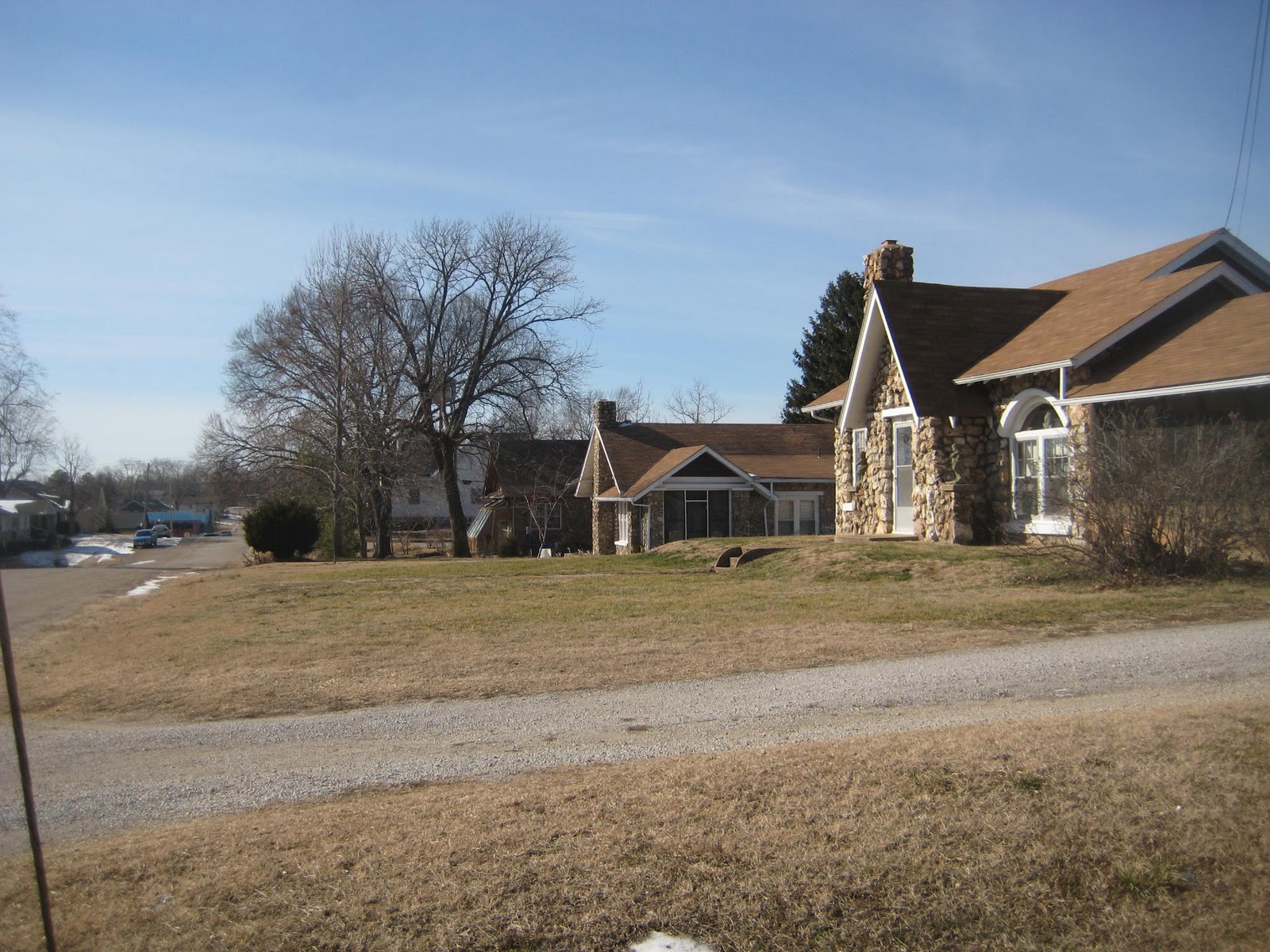
In the 1920's and 1930's Missouri and Arkansas Ozarkers made use of field stone for home construction.  Some builders specialized in constructing stone houses.  As you might imagine, these buildings were very sturdy and most persist. 

These "three-in-a-row" stone houses (right)  are on Third Street in Mountain View, Missouri. 


The structures on Third Street must have been developed all in the same era, because there are several stone houses along that street. 


This is a different view of that same Third Street stone house (left). 

At the corner of Third and Elm is a stone building that has been a auto repair garage for many years (right).  And a block west is the original Mountain View fire station (left below).  More modern exteriors were added to the fire station in later years.  


Native rocks were commonly used for retaining walls (right below). 


 Many rural school houses were built with native stones.

 The building below was the Trask School at one time. 


Rural homes were also often constructed using local stones.  The house pictured below (center) was built by Earnest LeBaron, my great-grandfather.  My grandparents lived there all their lives and my mother grew up in that house.  All the rocks were gathered right on the farm. 


Rocks are usually a nuisance, especially to farmers.  But in the Ozarks, where we have plenty, our rocks sometimes have been quite useful, and beautiful. 

Wednesday, November 10, 2010

Weather? Hot and dry.


This is a photo of our brown front lawn on August 19. In the center is the “stump” of our new maple tree that we planted in the fall of 2009. As you can see, our new tree didn’t make it. And our weedy lawn turned brown and ugly.
The news in summer included reports of flooding in Iowa, northern Missouri, Oklahoma, and western Arkansas. But Mountain View was in the center of a circle of low rainfall; drought really. Our soils are thin to non-existent. Ozark soils are rocky and very well drained. It dries out fast around here. We need about an inch of rain weekly in the summer to keep pastures and lawns green.
I’m so thankful that September rains came and also brought some cooler air. July and August 2010 were very hot and very dry in my corner of the Ozarks. We had 7.5 inches of rain in September which is almost twice the average. I thought the drought was broken.
But October brought more dry air, dry skies, and dry soil. We had only one measurable rain in October and it was only 0.3 inches. Nothing yet in November.
We’ve had a warm fall, which is pleasant, especially after a miserably hot summer. The heat started early. We had 15 days in the 90’s in June including 98 three times. In late July we had 17 straight days at 90 or above. From August 1-25 the daily high fell below 90 only two days. We had seven days in August with highs of 100 or more. Yuk!
What’s next? I guess I’m going to open up some persimmon seeds and go in search of wooly worms to find out.

Friday, May 15, 2009

May 8th Tornado

Missouri doesn't seem to be in "tornado alley" as much as Oklahoma and Kansas, but we still get hit sometimes. In recent years, the worst storm damage has been northwest of Springfield. Last week, May 8, about 15 tornadoes hit the Ozarks. There were three fatalities statewide. Again, the area northwest of Springfield was hit hard. But a severe tornado damaged homes near Pomona in Howell County, only 15 miles southwest of Mountain View. And a smaller, but still powerful, tornado damaged homes and timber in Texas County about 8 miles north of Mountain View. Buildings in Mountain View were spared, but many trees and tree limbs came down, and much of the town was without electricity for about 10 hours.

Yesterday I toured some of the damage to the north and brought back some photos.


The elderly couple inside this home were both injured when the tornado moved the house 15 feet off the foundation. Neighbors had to clear a path with chain saws so the ambulance could get to them.


These trees, in the storm path just beyond the house, were twisted and snapped off.


Thousands of acres of timber were damaged. Salvage harvest operations are already underway. Logging it is dangerous because of many trees partially down and hanging in the overstory. The value of the logs will be greatly reduced.


Isaiah 45

6so that from the rising of the sun

to the place of its setting

men may know there is none besides me.

I am the LORD, and there is no other.

7I form the light and create darkness,

I bring prosperity and create disaster;

I, the LORD, do all these things.


By faith we understand that God is in control. God allows suffering for a season, but ultimately His supremacy will be revealed.