Monday, November 26, 2012

75th Anniversary

No.  It's not our 75th wedding anniversary, although each year we get a little closer to that accomplishment.  2012 is actually the 75th anniversary "wildlife conservation".  One could argue for other beginning dates, but
1937 was a big year for American wildlife.

 The Wildlife Society (TWS) was formed in 1937.  TWS is the international society of professional wildlife biologists.  About 11,000 wildlife biologists are members, most in the U. S. and Canada.

The early 20th century was a sad time for wildlife in America.  Market hunting, the Dust Bowl, and political non-scientific resource management had brought wildlife numbers to a low ebb.  The tragic status of wildlife prompted conservation pioneers to call for a comprehensive national policy for wildlife conservation.  Led by Aldo Leopold of Wisconsin, those early conservationists drafted the American Game Policy in 1930.  This document called for a program of wildlife restoration implemented by scientifically trained professionals with a stable funding source.

The second major event in 1937 was passage of the Pittman-Robertson Wildlife Restoration Act (P-R) which provided funding to the states for science-based wildlife conservation from a federal excise tax on sporting firearms and ammunition.  Some have argued that without P-R wildlife populations and habitats would not have recovered.

For those of us in Missouri, we celebrate another event from 1937:  the establishment of the Missouri Conservation Commission.  This new agency came about by a citizen-led campaign to amend the state constitution.  Missouri became the first state with a non-political conservation agency with a science-based management approach and it became a model for the nation. 

Did these landmark events make any difference for wildlife?  Judge for yourself.  Missouri just completed the firearm portion of its annual deer hunting season with over 204,000 deer harvested.  In 1931-37 Missouri had a 3-day deer hunt averaging about 100 bucks harvested per year.  My grandfather was one of the lucky ones in 1937; he shot a nice buck in Carter County that year.

Illinois held its first modern deer season in 1957 with a harvest of 1,735.  The total deer harvest by all methods in 2011 in Illinois was 181,451.

Missouri was able to resume hunting of wild turkeys (my sport) in 1960.  That first hunt was for 3 days in 14 counties and the harvest was 94.  This year 40,477 turkeys were taken in the spring season for gobblers and 8,498 in the fall firearm season.

There are still many challenges facing the wildlife conservation movement.  Land use and economics are overriding factors influencing wildlife habitat, especially for upland species like bobwhites and grassland songbirds.  Wetland drainage continues to reduce habitat for waterfowl and shorebirds.  And there are many other issues to face.  But I'm glad there are wildlifers out there working on those problems. 

Friday, October 19, 2012

Ozarks Wild Harvest

A huge harvest of a wild crop is underway in My Corner of the Ozarks.  (I usually write about turkey hunting which is still important to me.)  But this time I'd like to point out the 25 million pounds of black walnuts that will be picked up by families, scout groups, church groups, retirees, and others and sold to the Hammons company from Stockton, Missouri. 


Our native black walnut grows wild in forests and towns all across the Ozarks.  According to their website, Hammons has been buying from the public since 1946.  They sell the packaged walnut nutmeat in grocery stores in 32 states.  The buying season began October 1 (same as the fall turkey season).  Folks haul their hand-picked "black gold" to one of 260 buying stations in 16 states.  We have three in our local area:  Willow Springs, Birch Tree, and Summersville.  

My dad has several black walnut trees in his back yard.  He has to pick them up in order to be able to mow his lawn.  So, he always bags them and sells them or gives them to someone else to sell.  This year's crop was smaller than usual.  And some nuts were smaller, possibly due to the dry summer we had. 

According to Hammons Products Company, 65 percent of the nation's black walnut production comes from Missouri. 

I love it when someone sees a demand, gets an idea, and has success with it.  Especially when a country family sells something to city folks. 

And that's how that wonderful black walnut flavor and crunch makes it into ice cream, sweet breads, and cakes all over the nation.


Friday, August 3, 2012

It really is a drought!

 It's official.  Howell County is a disaster area due to heat and drought.  That's probably not news to most readers since nearly 1,300 counties in 29 states are in a drought disaster, according to the U. S. Dept. of Agriculture.  It's the most wide spread drought in the U. S. since 1956.

At right is a photo of my front yard rain gauge on July 2 waiting for a rain.   We received 1.7 inches of rain in Mountain View in first 8 days of July and no more until August 1 when a piddling 0.3 inches fell. 

The next photo is our front yard on August 3.  Even my weeds are dying. 

 Our average July precip is 3.7 inches.  Normally in January-July we receive 25.7 inches of precipitation.  This year we've had 18.1 inches, a short fall of 7.6 inches. 

The average annual precipitation is 43.7 inches at Mountain View.  We have a long way to go.   

Then... add to that the extreme heat, the worst since 1954.  We've had 11 days in July when the high temperature reached 100 degrees or more. 


Our drought started in April.  January-March had near normal rainfall.  Then May was even worse.  May is usually our highest rainfall month, but this year we had only 1.3 inches compared to nearly 5 normally. 

It was a terrible year to plant pine trees to grow for Christmas trees.  Most of mine didn't reach Independence Day.  Sad pine at right. 


Tuesday, May 8, 2012

New business, no it's a hobby

In April 2011 I started my new business.  I planted 51 Scotch pine seedlings.  The plan was to grow them into Christmas trees and reap big profits.  A $1 seedling, if it survives and is properly pruned, will sell for $20 in Mountain View.  Sounds good!

 However, there is a little more to the story.  After one year only 38 trees survived.  The remaining 38 are looking good.  They should be ready to sell in five more years. For a real business to work, I need to plant 50-60 trees each year and harvest about 40 per year. 

Then there are the other expenses.  After a year of record-keeping, I added up the cost of mower gasoline, irrigation water, herbicide, and tools.  Add in a few miscellaneous expenses, and I figure I can expect to clear about $235 per year on this so-called business. 
So..... I have decided to call this enterprise a "hobby".  (I'm retired.  I can have all the hobbies I want.)  If I make a couple hundred bucks some year, I'll file a Schedule C.  No big deal.  If 25% die, like they did last year, no big deal. 

 So this year I ordered more 75 Scotch pine seedlings to stock the David Pine Patch.  (I even registered my business name.)  On April 19 I planted 78 more seedlings.  About five have already died.  We need rain.  (That is increasing my irrigation expense.) 

Granddaughter Karis picked out this seedling on the left as her favorite baby Christmas tree last summer.  When we sell it Karis gets all the income from her favorite tree. 


The tree on the right is Granddaughter Olivia's favorite tree.  When we sell it Olivia gets the proceeds.  This offer is open to other grandchildren who might come and select a tree. 

Sorry, this offer applies only to grandchildren. 


Tuesday, May 1, 2012

Men's Legacy Retreat & Golf Tournament

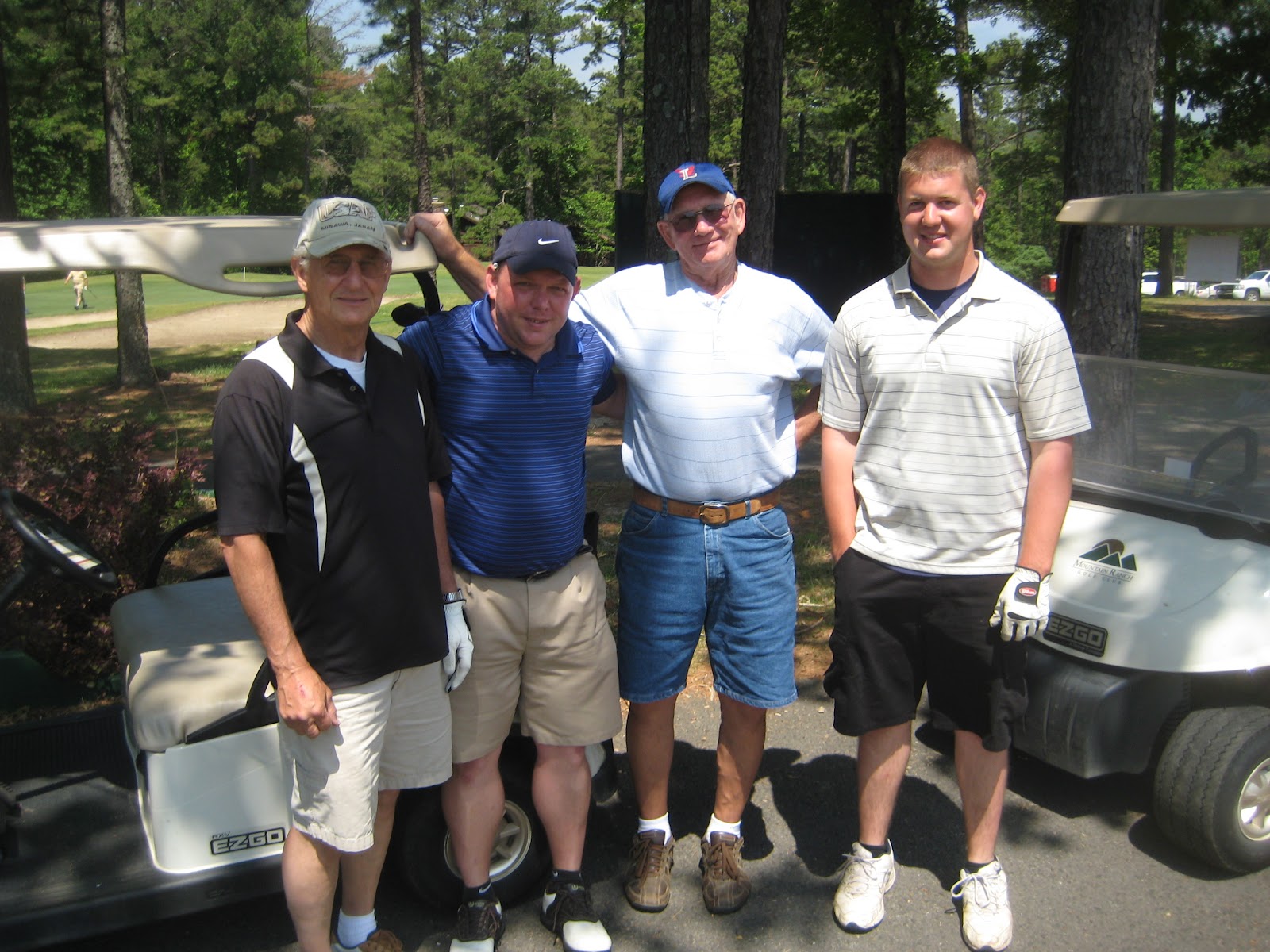
On April 27-28 twelve men from Mountain View participated in the 14th Annual Men's Legacy Retreat & Golf Tournament at Mountain Ranch Golf Club at Fairfield Bay, Arkansas.


 Mountain Ranch is a beautiful course in the rolling hills adjacent to Greer's Ferry Lake.  Many holes are very challenging.  We played a practice round on Friday and the tournament on Saturday.

We took meals and lodging at Budd Creek Baptist Camp.  Friday evening included a challenging sermon for men from a young pastor.   

 The tournament is played as a 4-man scramble.  These are my three teammates, Bob Heller, Brad Jester, and James Chambers.  I let them know right off that the only reason I was on their team was to make it a legitimate foursome.  We shot a 9 under par 63 in the contest. 

This is the second team from Mountain View; John Dewick, Brian Denton, Gene Colter, and Jack Spencer.  Brian is our "organizer".  He is formerly from Arkansas and played in this tournament with his church there.  He started taking one team, then two, and this year he took three teams.  


The third team consisted of Glenn Miller, Mike McAfee, Bob Acklin, and Buddy Seibert.  Buddy won the longest drive contest.  Glenn got "my door prize".  I had won a door prize each of the three previous years.  Well.... I guess it was Glenn's turn.,  

There was a "log jam" at the turn.  Jack and Gene were relaxing as they waited for their turn to tee off on Number Ten.  I don't know what they scored, but all Jack could talk about was the fish fry that awaited at the end of the round. 


Only Buddy brought home a trophy.  Only Glenn won a door prize.  But we all brought home sore muscles and good memories. 

This is the link to the Men's Legacy Retreat and Golf website:   http://www.menslegacyretreat.com/


Sunday, April 15, 2012

Two Eagles


Saturday was a red-letter birding day for our backyard.  It was a first-ever sighting of a bald eagle from our back deck.  I didn't take the eagle photo at right. Our eagle was much higher and I could only see the white tail feathers when it turned "just right" in its circle. 

That sighting prompted us to record all other bird life observed for the day.  I also heard wild turkey, northern bobwhite, and tufted titmouse.  The woodlands surrounding our subdivision make it possible, on a good day, to "extend the ear" into the forest.  We also spotted these in our backyard Saturday:  northern cardinal, redwing blackbird, American crow, mourning dove, brown-headed cowbird, eastern meadowlark, and American robin.

The most common species for the day was American goldfinch.  The bright fluttering noisy goldfinches flitted among the feeders, trees, and lawn.  There must have been three dozen.

The second eagle of the week was posted by my Uncle Butch (Wayne David) on Number Three at Mountain View Municipal.  He pitched in his third from the fairway on the Par Five.  He is no stranger to golf glory.  He's had two aces in his life.  Of course, anyone who plays as often has he does should get a lucky roll now and then.